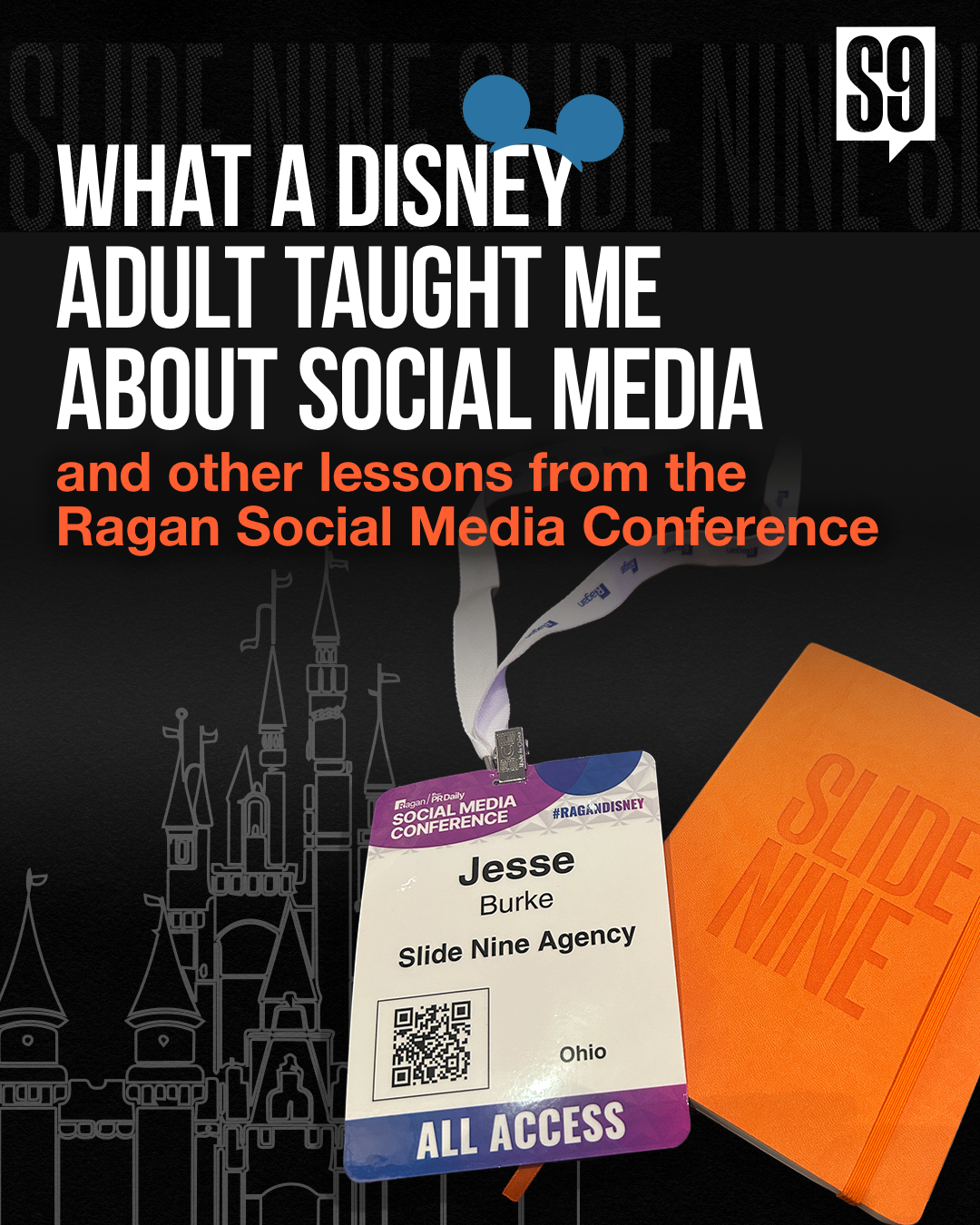
What a Disney Adult Taught Me About Social Media and Other Lessons from the Ragan Social Media Conference
S9 Account Executive Jesse Burke shares his insights from the 2026 Ragan Social Media Conference.
By Jesse Burke, Account Executive
Earlier this month, I had the privilege of spending three days in sunny Orlando attending Ragan’s Social Media Conference. My days were packed with sessions from some of the brightest minds in social and conversations with professionals across industries — healthcare, utilities, retail & travel, B2B SaaS, to name a few.
By the last day, I walked out of the conference feeling energized and motivated… but also unsure where to start. It wasn’t until a conversation in my Uber ride to the airport that things really started to click.
My driver told me she drives nearly an hour every day to EPCOT just for the Guardians of the Galaxy ride — and she’s been on it more than 2,000 times! Even with passes at Universal and SeaWorld, Disney still stands out to her: the high-production elements while waiting in line, the hidden easter eggs she discovers even after all these rides and the randomized playlist of 70s and 80s songs (mine was “September,” for all you Earth, Wind & Fire fans).
In a place designed to capture attention wherever you look, something stood out to her enough to keep her coming again and again (and again). That’s when it clicked. Throughout the conference, the same themes kept appearing: earn trust, capture attention and stay curious. No matter the platform, algorithm or shiny new trend, people return to what earns their trust, captures their attention and surprises them enough to make them curious.
Trust has always been the foundation of a solid social media strategy. But in today’s feeds of AI-generated content and misinformation, earning the trust of your audience has never been more challenging. As Rohit Bhargava of The Non-Obvious Company put it, “People who understand people will always win.” It’s no longer enough for brands to rely on polished or stunning campaigns. On today’s feeds, consumers want authenticity.
This includes AI-assisted content, with 99% of consumers insisting a brand’s personality must stay present in all messaging. (Animoto)
This shift is already happening on the individual level. As Paulette Bleam from the American Academy of Physician Associates (AAPA) notes, “Trust is shifting from brands to individuals.” In fact, Nielsen reports that nearly 90% of consumers trust recommendations from people they know more than any other channel. To put it simply: today’s success is found less in how you say it and more in who is saying it.
Here’s how you can start earning trust today:
Our social feeds have never been so crowded, and at the same time, our attention spans have never been shorter.
The data backs this up. According to Metricool’s 2026 Social Media Study (which analyzed a whopping 39 million posts), platforms are experiencing huge increases in content volume while simultaneously seeing decreases in visibility and engagement metrics. “To stand out, content needs to be 100 times better,” Brent Bowen from Sparkade Marketing emphasized.
This all comes down to creating content your audience is actually interested in or searching for.
In video content specifically, timing is everything. Julia Sarfati from PlayPlay warns, “Deliver value in the first twenty seconds, or risk losing your audience.” Capturing attention isn’t about having more content or being the flashiest; it’s about being the most relevant to the audience you’re trying to reach.
So, as feeds become overcrowded and visibility declines, reach alone is no longer enough. Now, attention is your most important metric.
Here’s how you can start capturing attention today:
Every social media professional has that one post (or fifty). You know, the one you were certain would perform, and then it doesn’t land… or worst case, it “flops.”
Commeriserating on moments like these came up quite often during the conference. We discussed how it’s best to view these as tests, not failures. As Laura Harrison from the National Audubon Society put it, “Failure is data. Small teams can’t afford to repeat what doesn’t work, so reflection is essential.” The brands crushing it on social aren’t avoiding mistakes; they’re learning from them and trying again.
This can mean letting go of the playbook you thought you knew. As Emily Synder from American Airlines shared, “Chart your own path.” What resonates with one brand may not work for another. The important lesson is to stay curious and keep learning. It’s less about chasing trends and more about being willing to try.
Here’s how you can put curiosity into action:
In a space that is obsessed with trends and what’s next, this conference was a nice reminder of what still works.
Days later, I’m still thinking about my Uber driver who makes that hour commute — over and over again — for an experience she knows is worth it.
In these fast-moving and overcrowded social feeds, that’s the least we can hope to achieve. Not just to be seen once, but to create an experience our audiences want to come back to.
And this success comes from rooting ourselves in the basics: building trust, earning attention and staying curious enough to keep improving.